.svg)

.avif)


This leading academic health system provides comprehensive clinical care across inpatient and outpatient facilities in the Midwest, with roughly 6,500 employees and growing following its integration with a regional medical center.
As part of a large public university system, the organization operates with a culture rooted in patient care, clinical excellence, and supporting the people who deliver it.
This customer story features insights from the health system's Employee Experience Strategist, who oversees ADA accommodations management across its hospital and clinical workforce.

When the Employee Experience Strategist at this leading academic health system describes what accommodations management looked like before Disclo, he cuts straight to it: “It was the wild, wild west.”
The health system, the clinical arm of a large public university, comprising roughly 6,500 employees across hospital facilities and outpatient centers, had no centralized system for handling accommodation requests. Requests came in on paper forms or Word documents stored in various department drives. Individual managers made their own calls without consulting HR. In return-from-leave cases, some departments treated it as all-or-nothing: employees had to be fully cleared and “100%” before they could come back. Others accommodated freely, sometimes without regard for whether an employee could actually perform their essential job functions. There was no standard process, no audit trail, and no shared visibility.
“The left hand didn’t know what the right hand was doing, and vice versa,” he says.
What made this organization’s situation particularly complex is the unique nature of its workforce. Unlike a typical office environment, where accommodation requests may skew toward long-term disability needs, roughly 70-80% of its requests are temporary, such as employees returning from injury or illness who need light duty or modified responsibilities for a few weeks before they’re fully cleared.
Those requests were happening constantly, across every department, largely invisible to the HR team tasked with overseeing the process. Department leaders were making decisions about these requests seemingly in silos, approving or denying them subjectively.
The result was inconsistent treatment, untracked cases, and real legal exposure. One particularly complex case required the involvement of the Office of General Counsel and dragged on for nearly a full year, running up against the organization’s one-year personal leave cap before it was finally resolved.
“That was life-sucking and exhausting,” he says. “And that was just one of many examples where we said to ourselves, ‘There has to be a better way.’”
Despite the ‘before’ state, he wasn't actually searching for a software solution when he came across Disclo. He attended a webinar hosted by an employee relations software, where Hannah Olson, Disclo's Co-founder and CEO, presented on ADA accommodations management.
“You don't know what you don't know,” he says. “But everything Hannah was talking about struck a chord with what we were struggling with. And the timing was just right.”
He reached out to Hannah after the session and, from there, they moved quickly toward a decision. There really was no extensive vendor comparison. Disclo addressed exactly what they needed, and the compliance infrastructure behind it (including Disclo’s patented intake process and sole-source justification) gave the team the confidence to move forward with the organization’s security review.

By his account, the implementation process was about as painless as it gets.
The health system runs on a long-standing legacy HRIS — the kind of established enterprise system many large organizations rely on, with years of customizations and institutional history behind it. Integrating a modern platform with that kind of infrastructure could easily have been a multi-month IT project, but it wasn’t.
“For Disclo to be able to integrate so quickly and easily was remarkable,” he says.
From the team’s perspective, the go-live was almost anticlimactic. Disclo had everything ready to launch; his team simply chose the date. They went live with a soft launch, and new requests were directed to the platform as they came in. Word spread from there.
Today, the organization’s accommodation process runs entirely on Disclo. New cases originate in the platform and documentation lives in one place. Case histories are timestamped and accessible. And when a question comes up, whether it’s a login issue, a process question, or guidance on a complex case, he and his team have a direct line to Disclo’s expert support team and ADA specialists.
That guidance has also helped them to modernize some of their own legacy practices. Like many healthcare orgs, it has a predominantly female workforce, and with it, a high volume of pregnancy-related accommodation requests under the Pregnant Workers Fairness Act (which went into effect in June 2023). His team had previously required medical certification for every case, regardless of the accommodation type. Disclo’s accommodation specialists flagged that pregnancy-related requests didn’t necessarily warrant that same level of documentation unless the limitation or need for an adjustment is not obvious, and helped the team revise its policy accordingly.
It’s the kind of operational coaching that goes beyond what a software platform typically offers, and it has meaningfully shaped how the health system runs its program.
On medical verification more broadly, the improvement has been stark. Before Disclo, the process meant sending a form, waiting, following up manually, waiting again, and often chasing incomplete documentation from providers. It could take weeks or longer.
“Having all of that through Disclo is gold,” he says. “It’s just gold.”
Now, when medical verification is needed, it’s a single click. Most cases close within a week. When a provider is slow to respond, the Disclo team follows up. The tracking that used to fall on him and his colleagues, like manual check-ins, follow-up emails, and the mental overhead of keeping cases from slipping, is handled entirely by Disclo.
For the health system, the value of Disclo isn’t just operational efficiency. It’s documentation.
Some accommodation cases require careful judgment calls and, sometimes, the involvement of legal counsel. This is especially true for cases involving mental health-related diagnoses, which can be complex to navigate. What Disclo provides in those moments isn’t a decision, but a record.
“Having Disclo as our single source of truth for all that documentation is vital,” he says. “Whatever the outcome is, we have the documentation to support it.”
For an organization that operates under the scrutiny of healthcare compliance, employment law, and the ever-present possibility of an EEOC complaint, that trail matters. The time stamps, communications, and case history are all there, organized and accessible when needed.
He has one piece of advice for healthcare systems evaluating accommodations platforms: be ready for what you’ll find, but don’t let it intimidate you.
Organizations that have been managing accommodations informally may experience an increase in case volume once a formal system is in place. But he is quick to reframe what that surge actually means.
“If they’re anything like we were, be prepared for the spike in volume,” he says. “Because we were completely unaware of how many requests we actually had. Once we were able to systematically direct all of those accommodation needs to our team through Disclo, the volume exploded.”
The requests were always there, but what was missing was a place for them to go. And critically, a platform like Disclo doesn't just surface demand — it validates it. The structured intake process, documentation requirements, and medical verification workflow mean that every request that comes through is properly vetted. Companies don't have to worry about employees gaming the system, because the system itself is designed to ensure that accommodations go to the people who genuinely need them.
For HR teams nervous about opening the floodgates, this final point is for you. A spike in requests is a sign that employees who need support are finally getting it through a process that protects the organization just as much as it supports the individual.
“It's not that those employees didn't need support before,” as he puts it. “It's just that now there's a place for it to go.”
If your organization is looking to revamp your accommodations process, feel free to reach out to us at hello@disclo.com, or book time with us directly here.
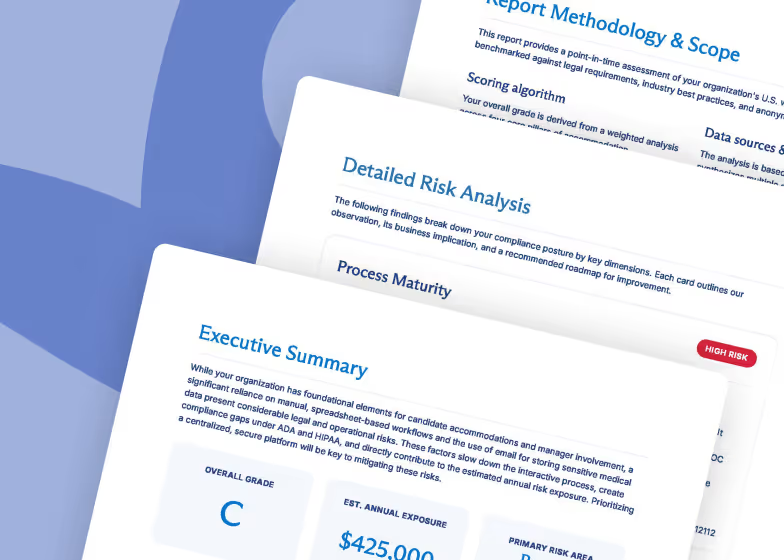
Your company may be at risk of costly legal action due to non-compliance. Discover your accommodations compliance risk today.


Outdated systems put you at risk. Check out the resources to learn how you can stay compliant, operate efficiently, and effectively support your employees.
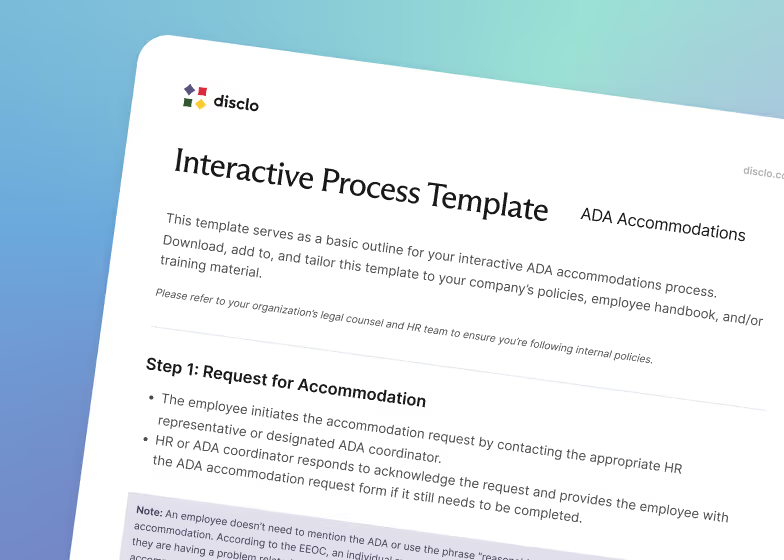
Use this basic outline to kick-start the interactive ADA accommodations process. Customize it to your business as needed.